How to Choose Between Visium, GeoMx, CosMx, and MERFISH for Your Study
A practical comparison of major spatial transcriptomics platforms — resolution, throughput, cost, and which biological questions each is best suited to answer.
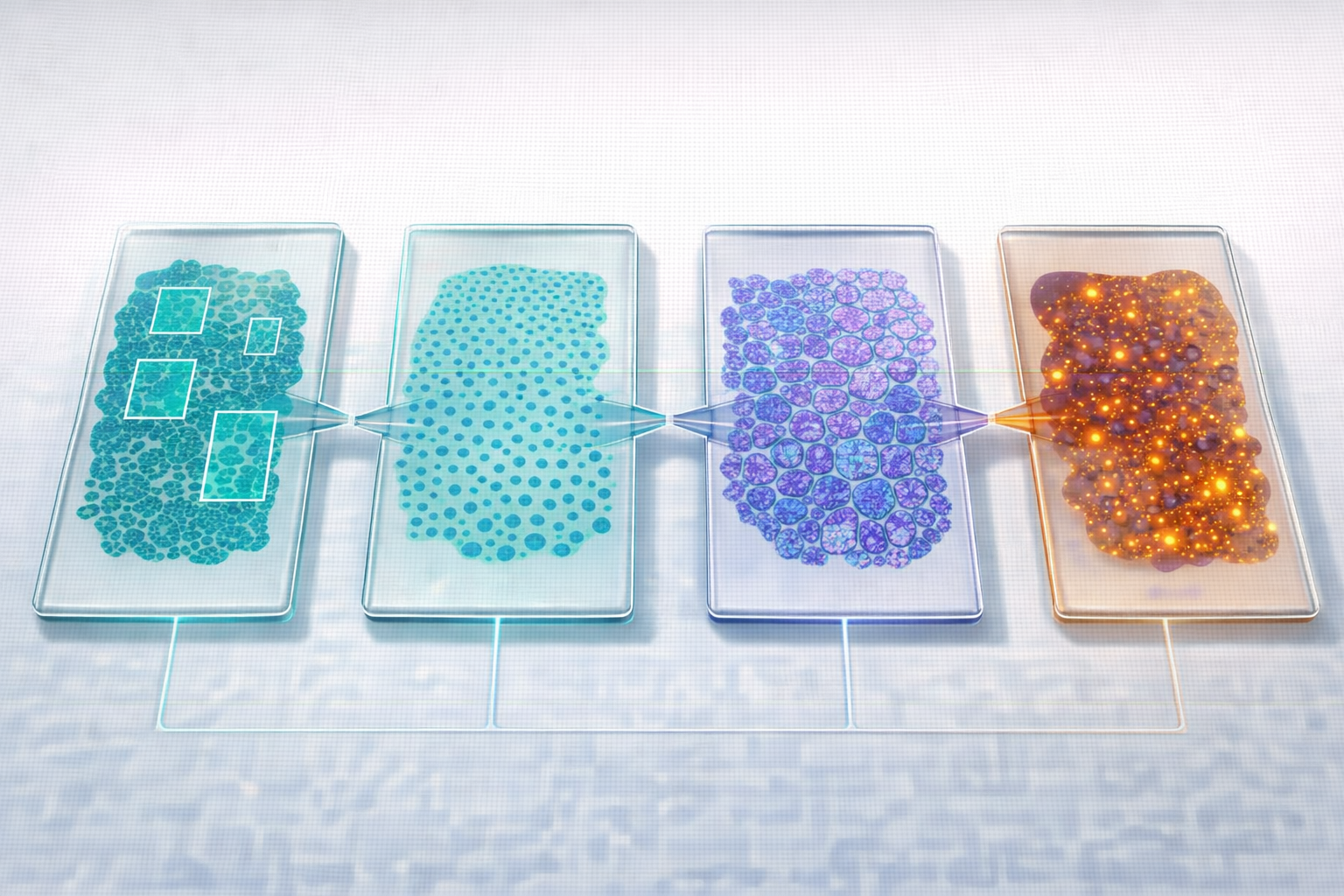
If you’re planning a spatial transcriptomics experiment, you’re facing a decision that didn’t exist five years ago: which platform should you use?
The answer depends on your biological question, your tissue type, your budget, and how much computational support you have downstream. There is no universally “best” platform — only the best platform for your specific study.
Here’s how to think about the choice.
The Landscape at a Glance
Note: Platform capabilities are evolving rapidly. The table below reflects representative use cases as of early 2026; check vendor documentation for the latest specifications.
| Feature | GeoMx DSP | Visium / Visium HD (10x) | CosMx SMI | MERFISH / MERSCOPE |
|---|---|---|---|---|
| Resolution | Regional (ROI, tens to thousands of cells) | Classic: 55μm spots (~1-20+ cells); HD: single-cell scale | Single-cell / subcellular | Single-cell / subcellular |
| Plex | Whole transcriptome (probe-based) or targeted panels | Whole transcriptome (capture-based) | 6K panels; whole-transcriptome options now available | Up to ~1,000 RNA targets in current commercial workflows |
| Tissue type | FFPE and fresh-frozen | Assay-dependent: fresh-frozen, FFPE, and fixed frozen | FFPE and fresh-frozen | Fresh-frozen and FFPE (workflow-dependent) |
| Protein + RNA | Yes (sequential profiling) | Primarily RNA; some CytAssist workflows support gene + protein for FFPE | Yes (antibody panels) | Primarily RNA-focused |
| Throughput | Moderate (12-96 ROIs per slide) | High spatial throughput per sample | Moderate | Moderate |
| User selects regions | Yes (ROI-based) | No (full coverage) | No (full coverage) | No (full coverage) |
| Commercial availability | Mature | Mature | Growing | Growing |
When to Choose GeoMx DSP
Best for: Hypothesis-driven studies where you know which tissue regions matter.
GeoMx is uniquely ROI-based — you select specific tissue regions to profile using fluorescent morphology markers. This is powerful when you have a clear hypothesis: “Is checkpoint expression higher in the tumor core versus the stroma?” or “How does immune infiltration differ between fibrotic and non-fibrotic kidney regions?”
Strengths:
- Works with FFPE tissue (critical for clinical archives and biobanks)
- Multi-omics (RNA + protein from the same section)
- Whole transcriptome coverage (probe-based)
- Flexible ROI selection guided by tissue morphology
- Well-established data analysis ecosystem (NanoString DSP software, GeoMxTools R package)
Limitations:
- Regional resolution, not single-cell — you get an average across all cells in each ROI
- Requires manual ROI selection (time-consuming for large studies)
- Throughput is limited by the number of ROIs per slide
Ideal for: Immuno-oncology, biomarker development, compartment-specific analysis (tumor vs. stroma vs. immune), multi-omics spatial studies, working with archival FFPE tissue.
When to Choose Visium / Visium HD
Best for: Relatively unbiased, discovery-driven studies where you want full tissue coverage.
The Visium platform family tiles the entire tissue section — classic Visium uses 55μm spots, while Visium HD achieves single-cell-scale resolution. There’s no ROI selection — you get comprehensive spatial coverage automatically.
Strengths:
- Relatively unbiased full tissue coverage without manual region selection
- Whole transcriptome (coverage depends on sequencing depth and capture efficiency)
- Good for discovery — you don’t need to know where to look
- Multiple assay options: classic Visium, CytAssist (streamlined FFPE workflow), and Visium HD (higher resolution)
- Tissue flexibility: fresh-frozen, FFPE, and fixed frozen depending on the assay
- Some CytAssist workflows now support combined gene and protein expression for FFPE
Limitations:
- Classic 55μm spots contain multiple cells (Visium HD addresses this with single-cell-scale resolution)
- Protein co-detection limited to specific CytAssist assays, not available across all Visium workflows
- Large data volumes require significant computational resources, especially for HD
Ideal for: Developmental biology, neuroscience, tumor heterogeneity mapping, any study where you want a broad spatial map of the whole tissue. Visium HD is particularly strong for studies needing higher resolution with FFPE compatibility.
When to Choose CosMx SMI
Best for: Single-cell resolution with spatial context, especially in FFPE tissue.
CosMx (now under Bruker Spatial Biology) provides true single-cell and subcellular resolution, imaging individual RNA molecules within cells in their tissue context.
Strengths:
- Single-cell / subcellular resolution (dependent on segmentation quality)
- Works with FFPE tissue
- Combined RNA and protein detection (antibody panels)
- 6K targeted panels available, with whole-transcriptome options now available
- Spatial relationships between individual cells are directly measurable
Limitations:
- Whole-transcriptome panel is newer compared to the established 6K panels
- Newer platform — smaller installed base, evolving analysis tools
- Data analysis is computationally intensive
- Higher cost per sample than regional approaches
Ideal for: Cell-cell interaction studies, immune synapse biology, detailed tissue microenvironment characterization, studies where individual cell identity and location both matter.
When to Choose MERFISH / MERSCOPE
Best for: High-plex single-cell spatial transcriptomics with very high quantitative accuracy.
MERFISH (Multiplexed Error-Robust Fluorescence In Situ Hybridization) uses combinatorial labeling to detect thousands of RNA species at single-molecule resolution. Commercially available through Vizgen’s MERSCOPE platform.
Strengths:
- High plex (up to ~1,000 RNA targets in current MERFISH 2.0 commercial workflows)
- Single-cell / subcellular resolution
- Highly quantitative at the single-molecule level
- Published extensively in neuroscience, developmental biology, and cancer
- Tissue flexibility expanding: fresh-frozen and FFPE workflows now available (MERFISH 2.0 / MERSCOPE)
Limitations:
- Computationally demanding
- Newer commercial availability relative to GeoMx and Visium
- Primarily positioned as an RNA platform (not typically used for combined RNA + protein in the way GeoMx or CosMx are)
Ideal for: Neuroscience (brain region mapping), developmental biology, high-resolution tumor heterogeneity studies, any application requiring high-plex single-molecule imaging at single-cell resolution.
Decision Framework
Start with your tissue
- FFPE only: GeoMx, CosMx, Visium (CytAssist and HD assays), and MERSCOPE FFPE workflows are all options — check specific assay compatibility for your tissue type.
- Fresh-frozen available: All platforms support fresh-frozen tissue.
Then consider your question
- Hypothesis-driven (you know where to look): GeoMx — select your ROIs and get deep profiling with multi-omics capability.
- Discovery-driven (you don’t know where to look): Visium — unbiased full-tissue coverage.
- Cell-level resolution needed: CosMx or MERFISH — individual cells in spatial context.
- RNA + protein together: GeoMx or CosMx.
Then consider practical constraints
- Budget: GeoMx and Visium are generally lower cost per sample than single-cell spatial platforms, though costs vary significantly by experimental design.
- Sample size: If you need to profile many samples (n > 20), regional approaches (GeoMx) or full-tissue approaches (Visium) are more practical than single-cell platforms.
- Computational support: Single-cell spatial data (CosMx, MERFISH) requires substantial computational infrastructure for analysis. Regional data (GeoMx) is more manageable.
- Analysis expertise: GeoMx has a well-established analysis ecosystem. Visium analysis via Seurat/Scanpy is well-documented. CosMx and MERFISH analysis tools are developing rapidly but are less standardized.
A Common Mistake: Choosing Platform Before Question
The most expensive mistake in spatial biology is choosing a platform because it has the highest resolution or the newest technology, rather than because it answers your specific question.
Single-cell spatial resolution is impressive — but if your study compares tumor vs. stroma gene expression across 50 patients, GeoMx ROI-level data will answer your question faster, cheaper, and with better statistical power than profiling millions of individual cells.
Match the platform to the question, not the other way around.
How We Can Help
Platform selection is one of the first decisions we help clients make at Cytogence. We’ve analyzed data from GeoMx, Visium, and CosMx studies, and we understand the practical tradeoffs beyond what’s in the marketing materials.
If you’re planning a spatial study and want guidance on which platform fits your experimental design, sample availability, and budget — or if you already have data and need analysis support — we’re here to help.
Cytogence provides bioinformatics consulting for spatial transcriptomics across all major platforms. Get in touch to discuss your study design.