Cytogence FCS
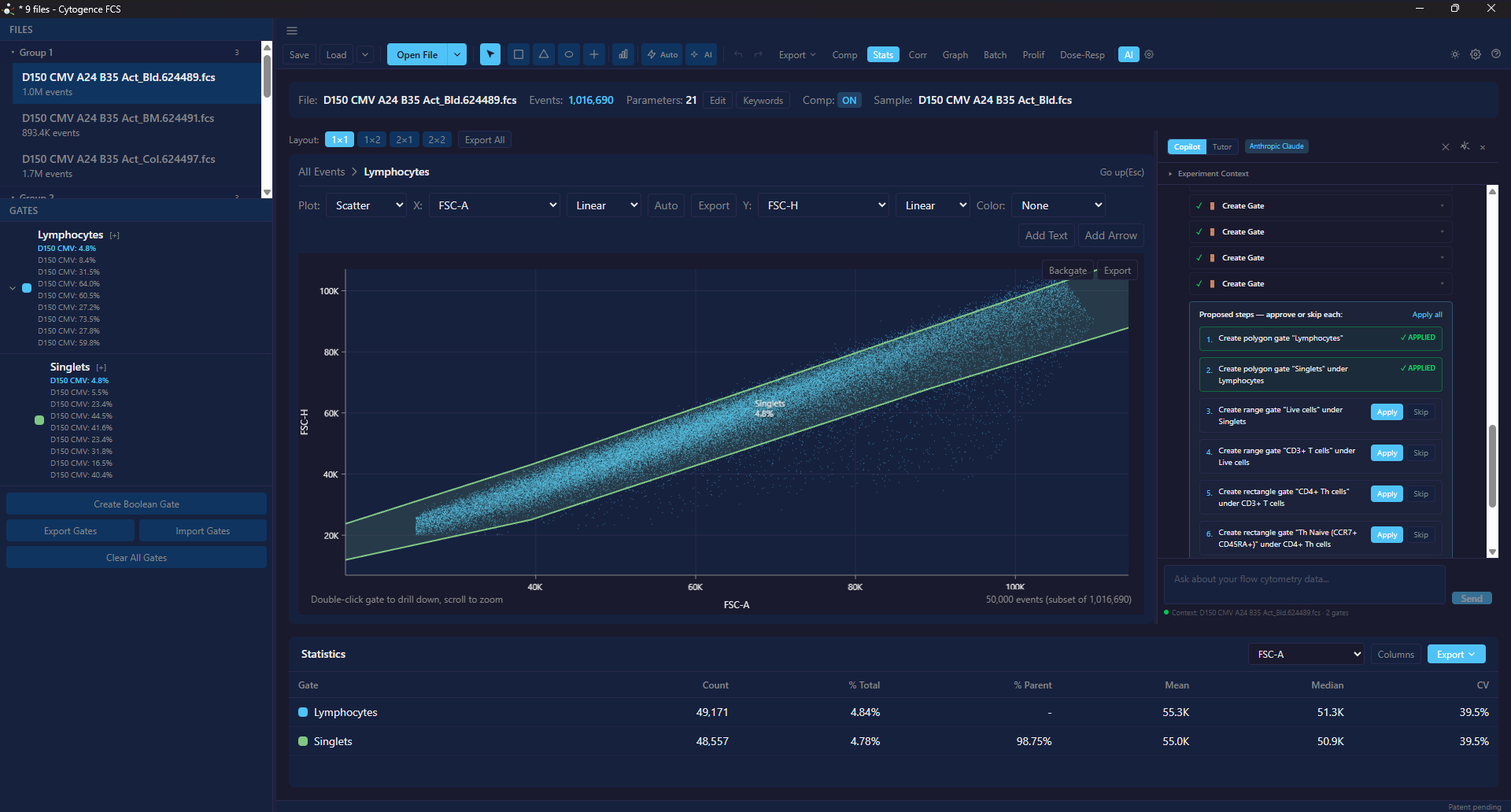
A high-performance flow cytometry analysis platform built from the ground up in Rust, pairing an AI copilot with a flow-cytometry-trained gating model that proposes gates for you to review. A native desktop app for Windows, macOS, and Linux.
Prefer to read first?
Built in Rust
Native engine built for large event files, with GPU-accelerated plots.
AI Copilot
Automated gating and strategy suggestions powered by LLMs.
Privacy First
All analysis runs locally. Data leaves your machine only if you choose a cloud AI provider.
Cross-Platform
Windows, macOS, and Linux with identical features, in 16 interface languages.
Everything you need for flow cytometry analysis
From file loading to publication-ready figures, Cytogence FCS covers the entire analysis workflow.
A gating model trained on real flow cytometry data
Alongside the AI copilot, Cytogence FCS includes a second AI — AI-1, our own model, trained specifically on flow cytometry data to identify cell populations. The copilot brings broad reasoning; AI-1 brings cytometry expertise. Together they propose a complete gating strategy that you review and approve.
Reads markers, not fluorochromes
It identifies each channel by the marker it measures rather than by its fluorochrome, detector, or channel order — so a panel it hasn't seen before is still interpretable to it.
Knows what it knows
The model reports its own confidence and flags data that looks unfamiliar, so you always know when a suggestion is well-grounded and when it isn't.
Hands off to the copilot
The trained model gates the populations it's confident about; the AI copilot fills in the rest — yielding one complete, hierarchical gating strategy instead of a partial answer.
Runs on your machine
AI-1 runs entirely on your computer — no account, no API key, no network — so your files stay with you while it works.
Part of Cytogence FCS, working alongside the AI copilot.
AI proposes, you approve
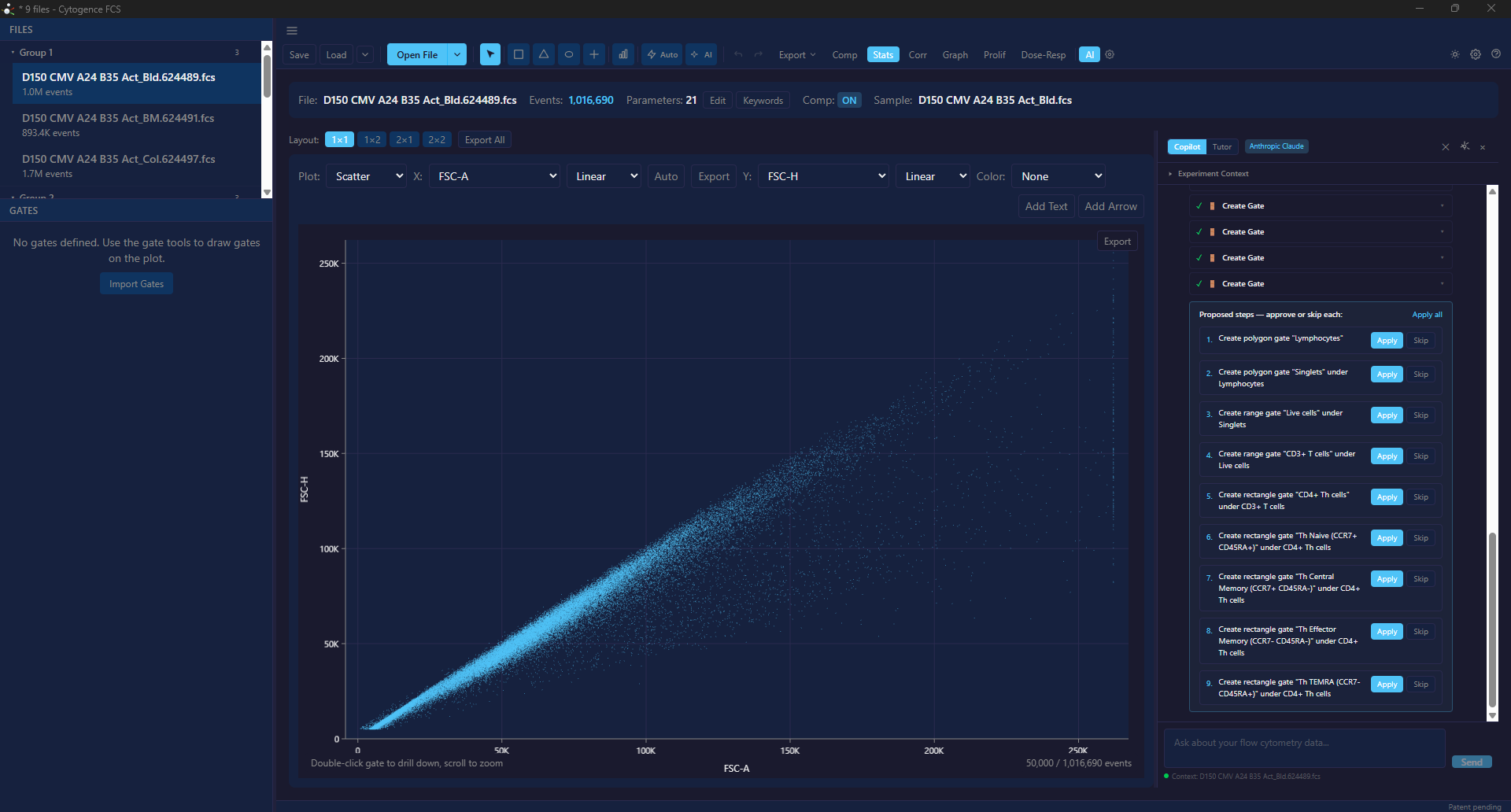
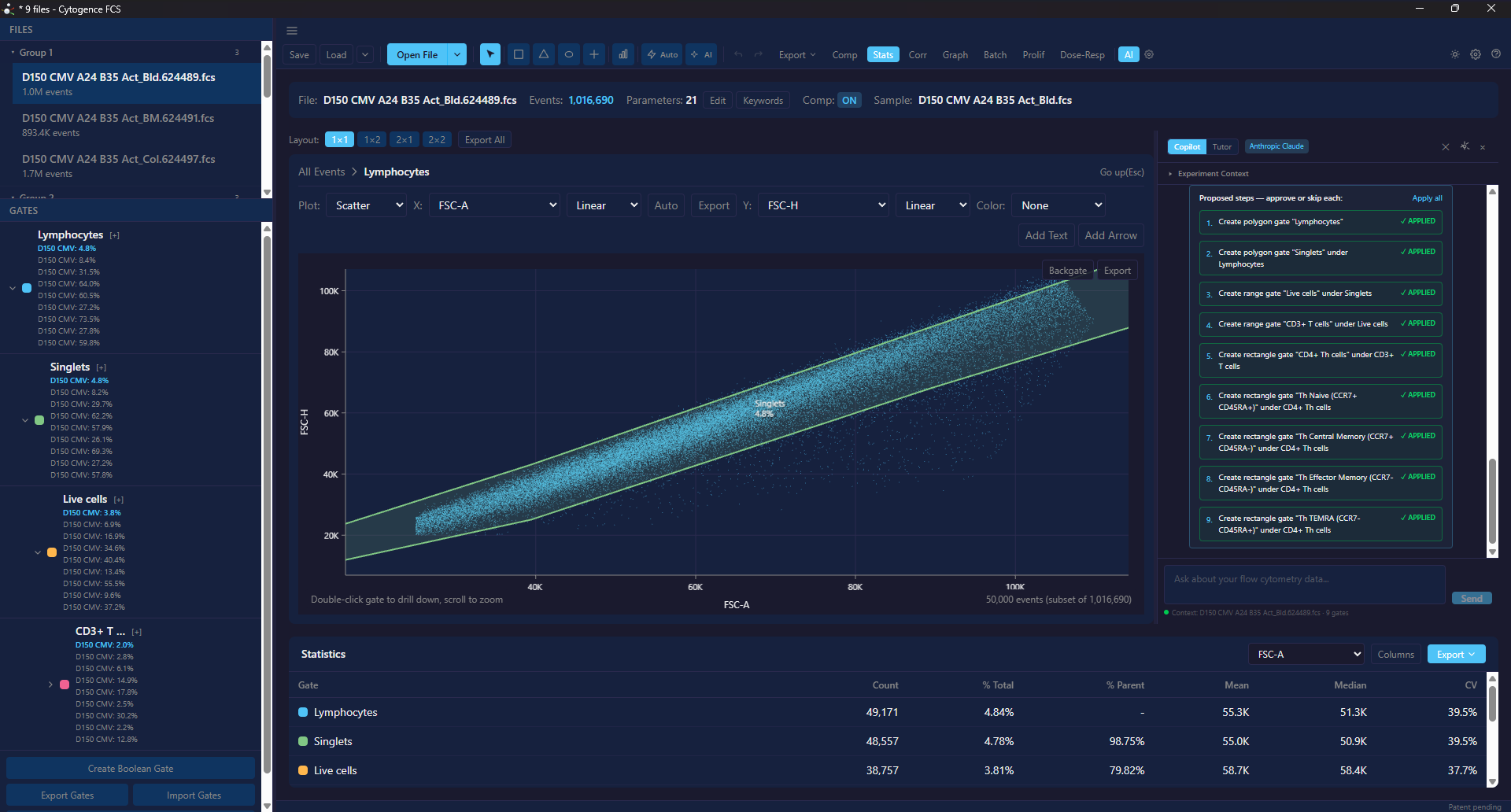
The copilot works through your data step by step and proposes each gate with a plain-language rationale — nothing is applied until you commit it. Every suggestion, tool call, and result is kept in a transparent, per-step log, so the analysis stays reviewable and reproducible.
Multi-Provider AI Copilot
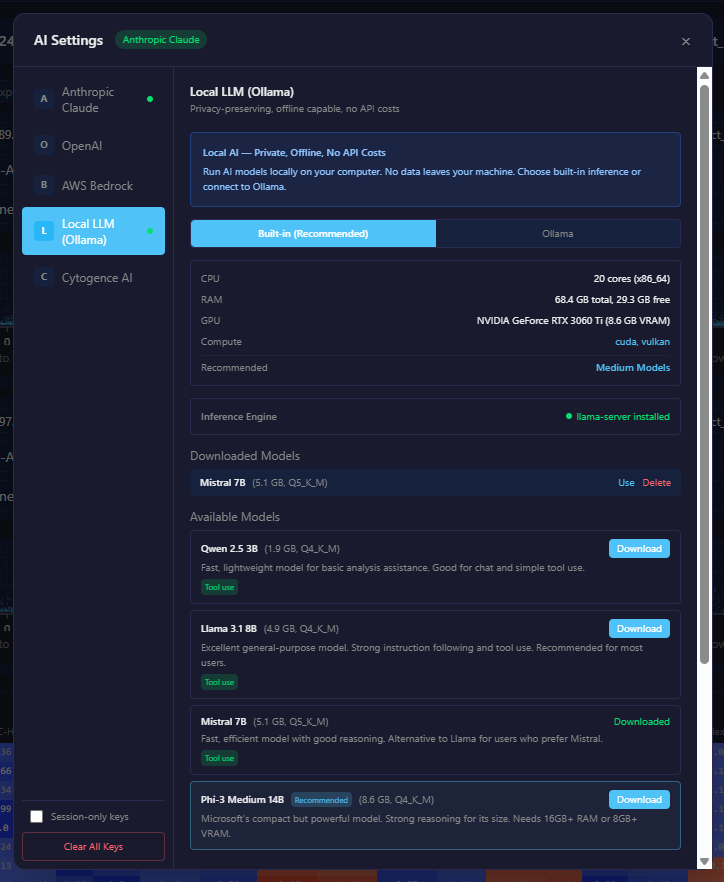
Choose from Claude, OpenAI, AWS Bedrock, or run a local model on the built-in engine or Ollama. Two assistant modes: Copilot for analysis and Tutor for learning.
ML Auto-Gating
Three clustering algorithms — K-means, DBSCAN, and Gaussian Mixture Models with BIC-based model selection — for unsupervised population identification.
AI-Exposed Analysis Tools
The AI assistant can create gates — including quadrant and boolean gates — compute statistics, suggest strategies, analyze distributions, name populations, and run statistical tests — all with your approval.
Figures From a Plain Request
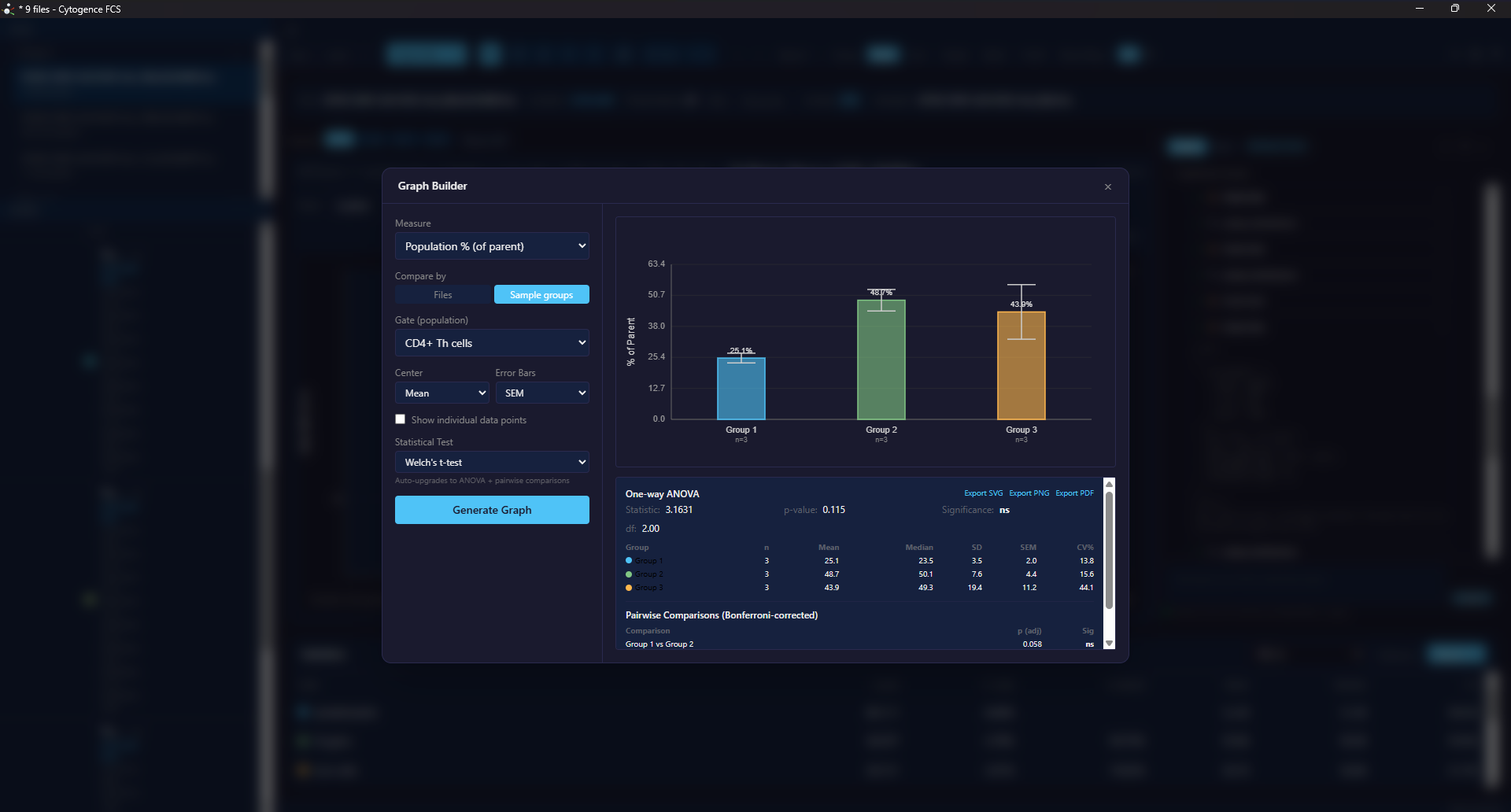
Ask for "a bar chart of IFNg in Group A vs Group B with the right test" and the copilot builds it in Graph Builder through the same controls you use, names the test it chose, and can export the figure. You always choose where the file is saved. Figures built with a local model are marked experimental.
Professional-grade analysis tools
Built on validated statistical methods and a comprehensive gating engine that supports hierarchical gate trees, boolean operations, and real-time population statistics.
Complete Gate Types
Rectangle, polygon, ellipse, range, quadrant, and boolean (AND/OR/NOT) gates with full hierarchy support, undo/redo, and real-time statistics. Every gate records who made it: you, AI-1, the copilot (with its provider and model), an import, clustering, or a copy.
5 Transform Types
Linear, logarithmic, biexponential (logicle), arcsinh, and hyperlog transforms with automatic tick generation for proper axis scaling.
Comprehensive Statistics
Mean, median, geometric mean MFI, and robust CV per population. Group comparisons: unpaired and paired t-tests, Mann-Whitney U, Wilcoxon matched-pairs, ANOVA, and Kruskal-Wallis — followed by Tukey, Dunnett's or Dunn's vs a control, Holm-Šídák, Benjamini-Hochberg, or Bonferroni — with a Shapiro-Wilk check beside every parametric result.
Propose, then approve — see it in action
The copilot lays out a full gating strategy with a rationale for each step. You execute the steps you agree with; gates and statistics update instantly. Nothing is applied without your click.
Cloud or fully local — you choose
Run the AI copilot on a frontier cloud model, or entirely on your own machine. Cytogence FCS ships built-in local inference and detects your hardware to pick a fitting model — so sensitive data can stay on-device.
Auto-Compensation
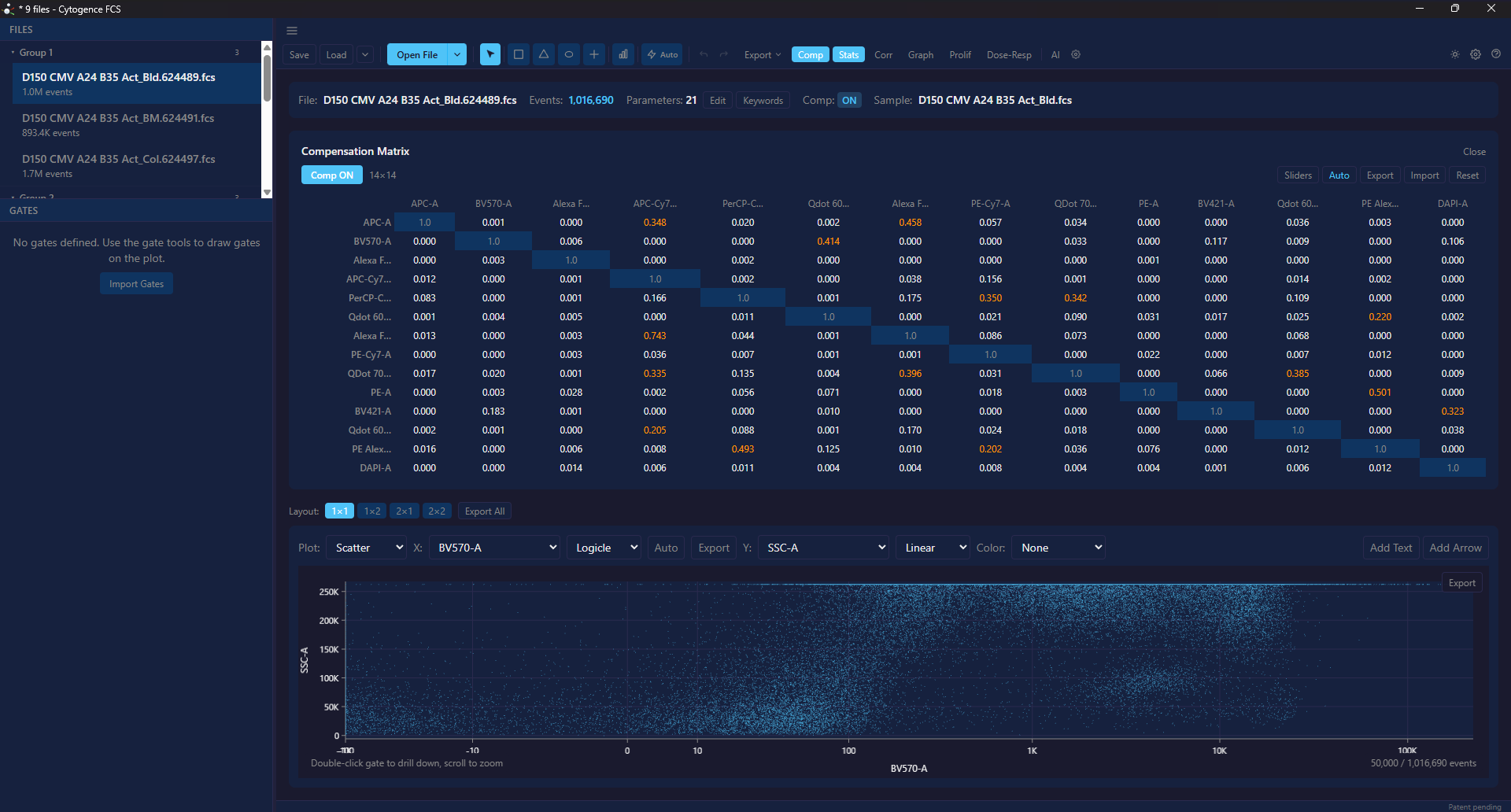
Calculate spillover matrices from single-stain controls with diagnostic metrics including stain index and FMO thresholds. Import/export matrices for sharing.
Proliferation Analysis
GMM-based dye dilution modeling with automatic generation peak fitting. Calculates division index, proliferation index, percent divided, and expansion index.
Dose-Response Fitting
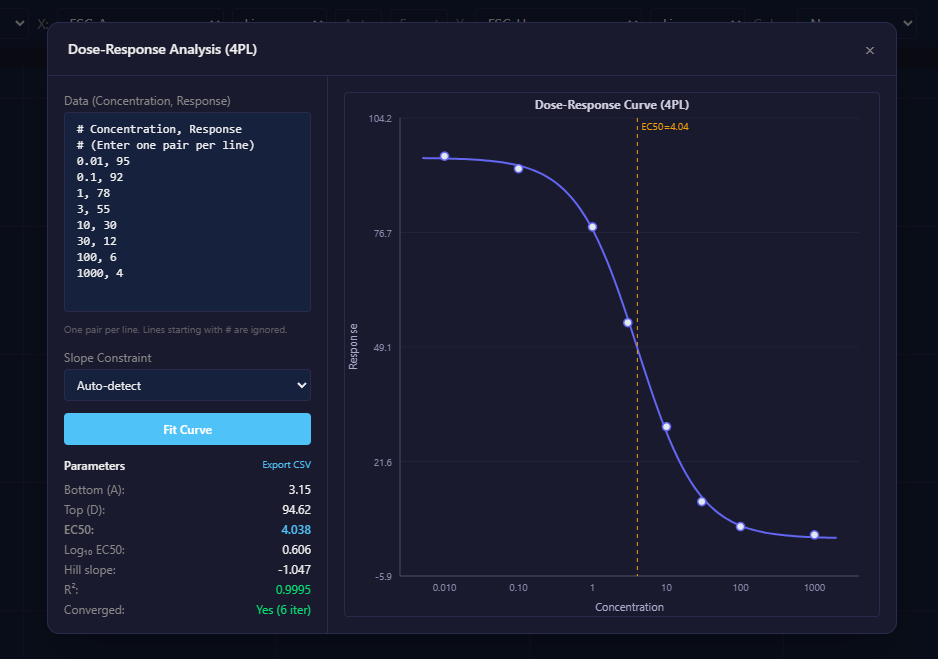
4-parameter logistic (4PL) curve fitting with Levenberg-Marquardt optimization. EC50/IC50 calculation with R² goodness-of-fit and convergence diagnostics.
GPU-Accelerated Plots
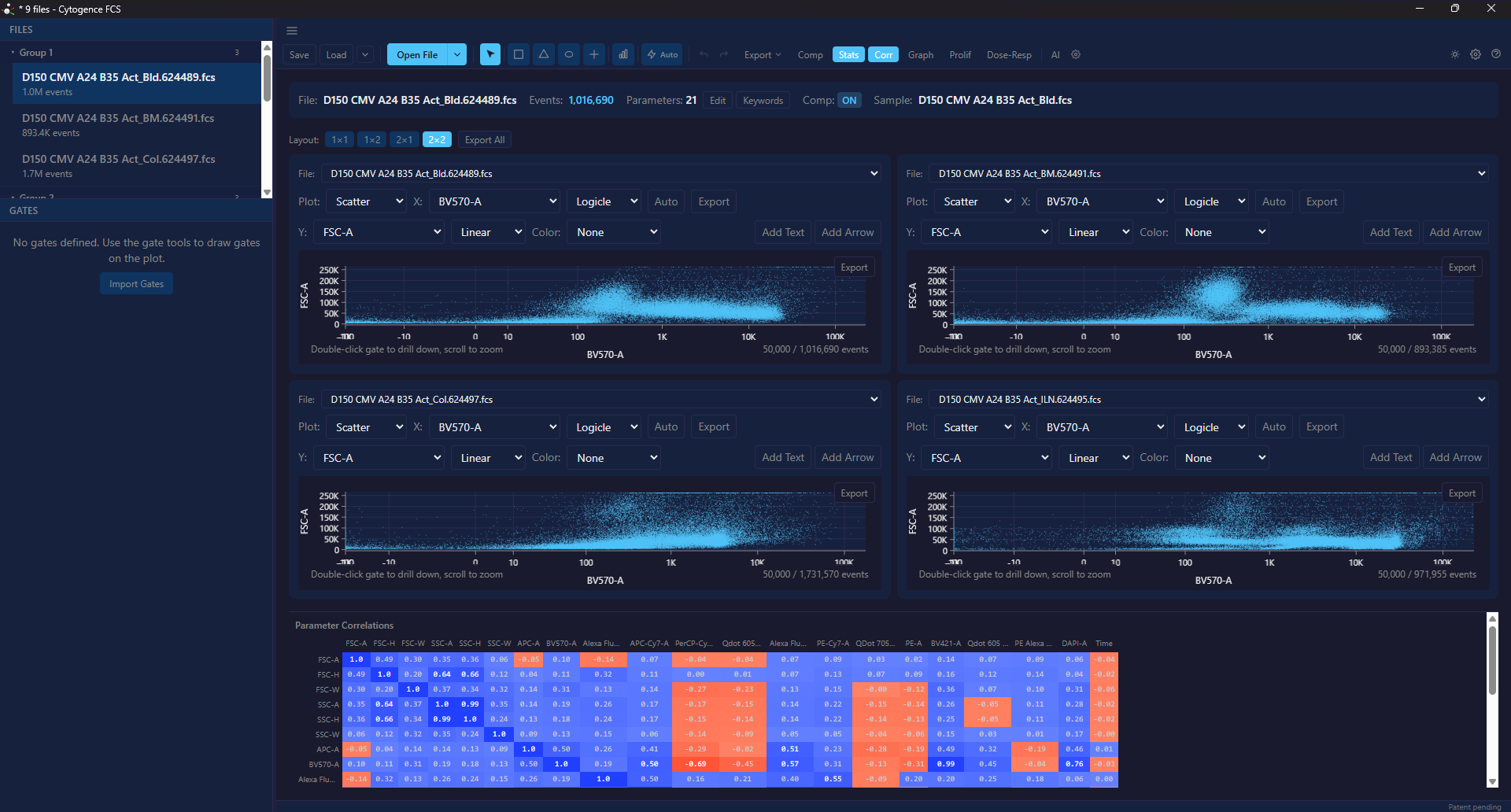
Scatter, histogram, density, contour, zebra, and overlay plots rendered via PixiJS with WebGPU/WebGL. Interactive zoom, pan, and configurable point rendering.
Publication-Ready Export
SVG and PDF figures are true vector drawings: axes, gates, and labels stay editable in Illustrator or Inkscape, and text is selectable. Print colours whatever the app theme, an optional title, and sizes in points; PNGs record their DPI. Export All saves every plot in the grid at once, and statistics and event data export as CSV.
Workspace Persistence
Save complete analysis sessions — files, gates, compensation, plot views — and restore them later, with a recent-files list to pick up where you left off.
A complete analysis workspace
Gating is only the start. Visualize, compensate, compare groups, and fit curves — then export publication-ready figures, all in one place.
Full FCS Standard Support
Cytogence FCS reads FCS 2.0, 3.0, and 3.1 files with support for integer, float, double, and ASCII data types. Drag and drop files to get started — metadata, parameters, and spillover matrices are extracted automatically.
Ready to try Cytogence FCS?
Request a demo and see how AI-powered flow cytometry analysis can accelerate your research workflow.
Or