Introducing PrimerGenie: Free qRT-PCR Primer Search for Over 40,000 Genes
PrimerGenie is a free searchable database of over 1 million computationally designed qRT-PCR primer pairs across human and mouse genomes, with quality scoring, specificity checking, and community validation.
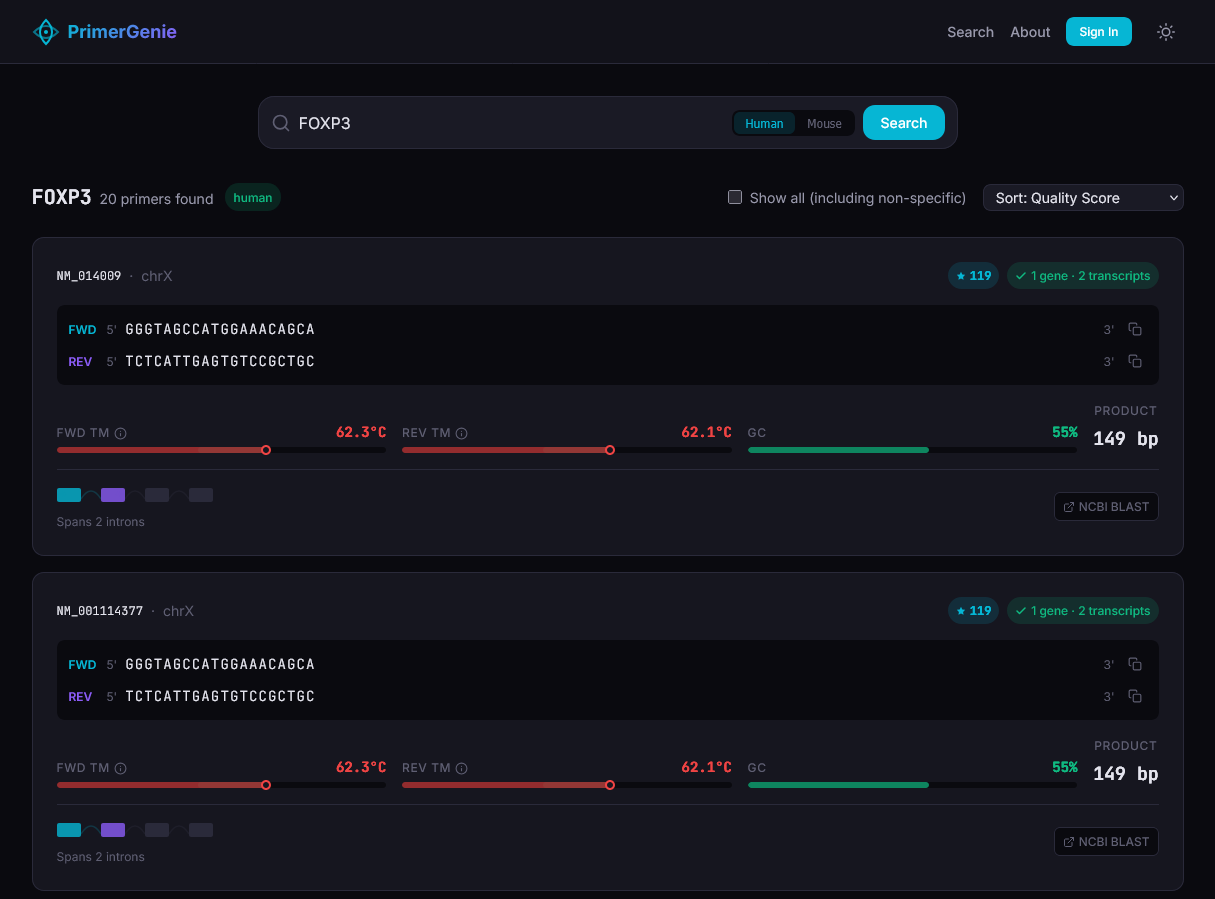
If you’ve ever needed qRT-PCR primers for a gene and lost an hour bouncing between old lab notebooks, published papers, and primer design tools — this one’s for you.
We built PrimerGenie to put that hour back into your day. It’s a free, searchable database of over 1 million computationally designed primer pairs across human and mouse genomes, with built-in quality scoring, specificity checking, and community validation.
Search your gene now at primergenie.com.
The Problem Every qPCR Researcher Knows
The workflow for picking primers hasn’t really changed in a decade. You need primers for a gene, so you:
- Dig through old lab notebooks and hope someone validated them before
- Search PrimerBank (a widely used resource, though not actively updated in recent years) to see what’s on file
- Run Primer-BLAST and wait for results
It’s not just slow — it’s frustrating not knowing whether the primers you pick will actually work. Choose the wrong ones and you don’t just lose time; you can invalidate an entire experiment. A failed qPCR run is 48 hours minimum: design, order, test, troubleshoot, redesign, order again.
There’s room for something better.
Why We Built PrimerGenie
After years of watching researchers — including ourselves — lose time on primer design and validation, we wanted something different: instant search, with quality already scored, specificity already checked, and a way for researchers to share what actually worked in the lab.
PrimerGenie is built by Cytogence, the bioinformatics division of KeyQ, Inc. Our team has spent years working at the intersection of molecular biology and computation — this is the tool we wish we’d had in grad school.
How to Use It (30 Seconds)
- Search — Type a gene symbol (e.g., TP53, FOXP3, Gapdh) at primergenie.com
- Pick — Top-scored primers appear first. Quality scores factor in intron spanning, Tm, GC content, and product size.
- Validate — One click opens NCBI Primer-BLAST with your sequences pre-filled. Or check community ratings from researchers who’ve used the primer.
No account needed to search. Sign in (Google, Microsoft, or ORCID) if you want to save primers or submit ratings.
What’s Inside
PrimerGenie covers 19,414 human genes and 21,105 mouse genes with primers designed specifically for qRT-PCR:
| Human (hg38) | Mouse (mm39) | |
|---|---|---|
| Primer pairs | 656,129 | 390,430 |
| Genes covered | 19,414 | 21,105 |
| Gene-specific | 93.6% | 93.2% |
| Intron-spanning | 97.3% | 96.1% |
Every primer pair is designed to span at least one intron where possible, so you’re amplifying cDNA — not genomic DNA. Single-exon genes are supported too, with clear flagging so you know when to include DNase treatment or no-RT controls.
Primers are computationally designed and should be validated experimentally — community ratings help indicate which ones have worked in the lab.
How the Scoring Works
Not all primers are equal. PrimerGenie scores every primer pair on criteria optimized for qRT-PCR:
- Intron spanning (+30 points) — The most important factor for distinguishing cDNA from gDNA
- Product size — 80-150 bp is ideal for qRT-PCR efficiency
- Melting temperature — Optimized around 62°C with matched forward/reverse Tms
- GC content — Centered at 55% for balanced amplification
The top-scoring primers appear first in search results, so you see the best options immediately.
Tm Calculations You Can Trust
Getting melting temperatures right was a priority. PrimerGenie uses the SantaLucia nearest-neighbor method with the Owczarzy et al. (2008) salt correction for divalent cations — the same approach used by NCBI Primer-BLAST. Our default conditions match standard PCR:
- 50 mM monovalent cations (Na⁺/K⁺)
- 1.5 mM Mg²⁺
- 0.8 mM dNTPs
- 250 nM primer concentration
Tm values are typically within ±1-2°C of NCBI Primer-BLAST. Every primer card includes a direct link to validate in Primer-BLAST with the sequences pre-filled.
Benchmark: 100 Common Genes
We benchmarked PrimerGenie’s top-ranked primers across 100 frequently studied genes spanning oncology, immunology, signaling, epigenetics, and housekeeping categories:
| Metric | Result |
|---|---|
| Genes with gene-specific primers | 100/100 |
| Mean Tm (forward and reverse) | 62.0°C |
| Mean Tm difference (fwd vs rev) | 0.14°C |
| Tm difference ≤ 1°C | 99% |
| GC content in ideal range (45-60%) | 100% |
| Product size in qRT-PCR range (70-200 bp) | 100% |
| Intron-spanning | 96% |
| Spanning ≥2 introns | 68% |
All benchmark genes returned primers meeting standard qRT-PCR design criteria.
Gene-Level Specificity: What “Specific” Actually Means
A common confusion with primer databases is the meaning of “specificity.” PrimerGenie reports specificity at two levels:
- Gene-level: Does this primer amplify only your gene of interest? A TP53 primer that hits 15 different TP53 transcript variants but no other genes is gene-specific — and that’s usually what you want.
- Transcript-level: How many individual transcript isoforms does it match?
For example, searching TP53 returns 150 primer pairs, all gene-specific (1 gene) despite matching 9-15 transcript variants. This is exactly what researchers usually want — detection of all TP53 isoforms without off-target amplification.
Community Validation
Here’s where PrimerGenie goes beyond a static database: researchers can rate primers based on real experimental results. Did it work? What cell line? What conditions? As usage grows, this builds a crowdsourced quality layer on top of the computational predictions.
Sign in with Google, Microsoft, or ORCID to contribute your results. If a primer worked — or didn’t — your lab’s next project can benefit from that knowledge.
What Success Looks Like
Instead of spending an hour hunting for primers, you spend 30 seconds. Instead of hoping yours will work, you see that other labs have already validated them. Instead of troubleshooting after the fact, you choose a quality-scored, specificity-checked pair up front — and get to the actual biology faster.
What’s Next
We’re actively working on:
- Additional species — Rat, zebrafish, and other model organisms
- Experiment design tools — 96-well plate layout for qRT-PCR
- qRT-PCR data analysis — Upload your Ct values, get ΔΔCt analysis and publication-ready figures
Try It
Search your gene at primergenie.com and get validated primer candidates in seconds. If you use PrimerGenie in your research, we’d love to hear about it — reach out at support@cytogence.com.
PrimerGenie is a free service of Cytogence, a division of KeyQ, Inc. Primers are computationally predicted; community reviews indicate experimentally validated primers. For research use only.